

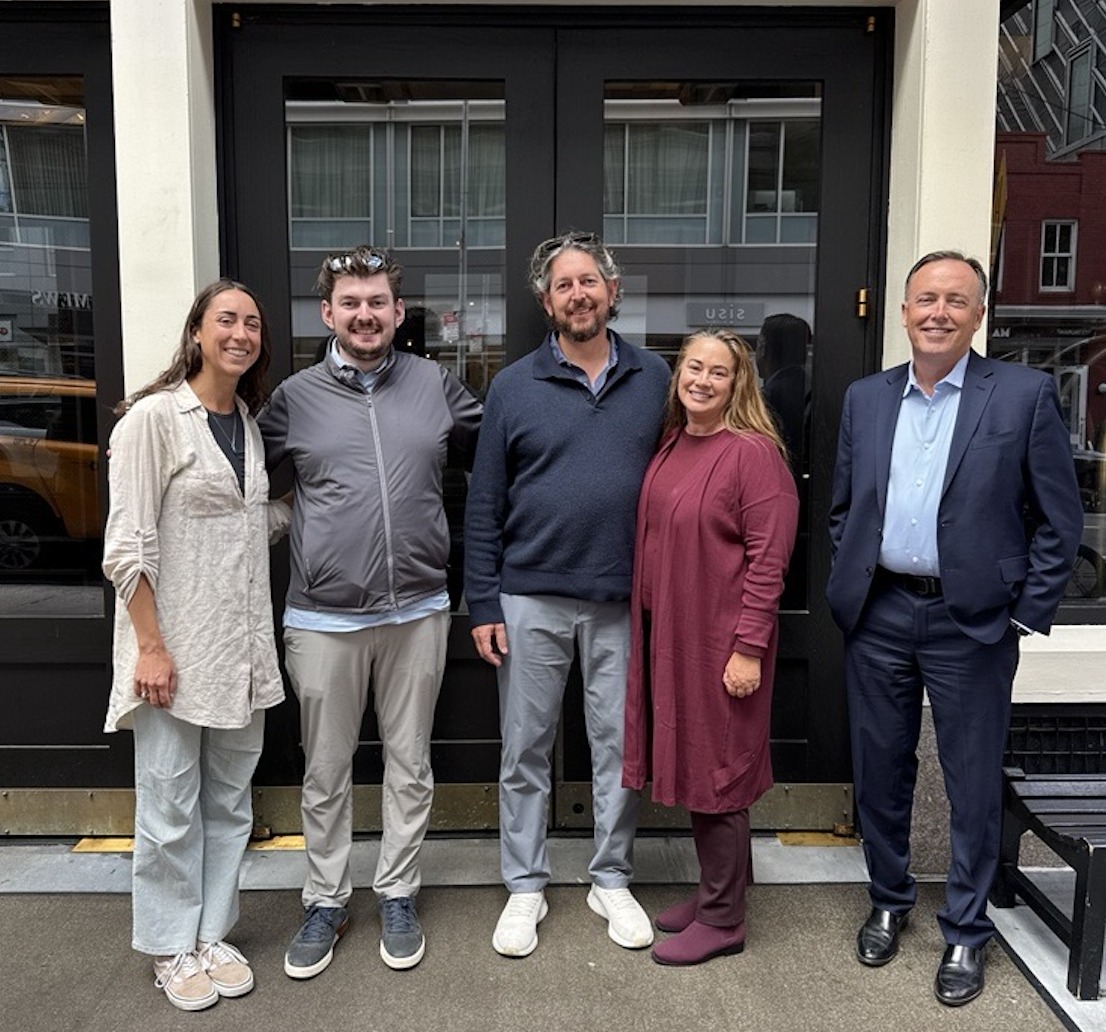
Last month, the Luminary team spent the week together in New York City for the 2026 edition of NYC Climate Week. Organized by Climate Group and held alongside the UN General Assembly, Climate Week has grown into the largest climate-focused gathering in the world. This year it drew more than 100,000 attendees to over 950 events across all five boroughs, bringing together startups, investors, corporate leaders, scientists, policymakers, and activists.
Between sessions, we shared meals, compared notes, and planned for the months ahead. Weeks like this one remind us how much we value working together and how much of what we do well grows out of that trust. Climate Week offered a window into the topics drawing the most attention across the industry. This year’s theme was “Energy. Impact. Action.” In the rooms we attended, the energy conversation centered on one topic above all: artificial intelligence, data centers, and the large loads they are bringing to the grid.
AI and the Load Question
Much of our week was spent at The Nest Campus, one of Climate Week’s largest gatherings which draws more than 10,000 attendees from over 100 countries.
The first session we attended, “Unlocking the Grid: An AI Solution for an AI Problem,” presented by Salesforce and Emerald AI, explored how AI can help manage the very grid constraints that data center growth is creating. Partway through, protestors seated in the audience interrupted to voice opposition to data center construction and the harm they see it bringing to their communities. The moment made clear that the debate over large loads extends well beyond stakeholder meetings and regulatory dockets.
The sessions that followed turned to how that demand might be met. In “Confronting the Data Center Energy Crisis,” NVIDIA and a panel of speakers argued that AI could help conserve roughly three times more energy than it consumes by 2030, while stressing that AI should be applied where it adds real value. On the supply side, DCVC and Radiant used “The Era of New Nuclear Energy Expansion” to present Radiant’s 1 MW microreactor, a self-contained “power plant in a box” designed to operate behind the meter.
Markets, Transmission, and Trust
If the sessions at The Nest focused on the scale of new demand, the Institute for Policy Integrity at NYU turned to the policy and market structures that will determine how that demand is served. Its conference, “Climate and Energy Progress Across the Political Divide,” returned repeatedly to areas of bipartisan agreement, including lower power costs, permitting reform, nuclear, and geothermal.
The conference’s most substantive panel brought together the Texas Energy and Climate Caucus and Powerhouse Texas, the Lighthouse Energy Institute, SparkFund, and Transmission Developers Inc. (TDI), representing perspectives from state policy, energy research, distributed storage, and transmission development. Together, the panelists offered a useful look at both the opportunities and the friction that come with rapid growth.
Texas illustrated both sides. Panelists credited the state’s energy-only market and its “connect and manage” interconnection approach for bringing new resources online quickly. They noted that ERCOT has reached a peak of 91 GW, with projections of up to 400 GW of demand within the next five to ten years. At the same time, proposed 765 kV transmission lines meant to keep pace with that growth drew 15 hours of public testimony at the state capitol and have since been paused.
New York offered a contrasting example. The panel discussed the Champlain Hudson Power Express (CHPE), the roughly 340-mile HVDC line from Quebec to Astoria that entered commercial operation in May and is designed to deliver about 1,250 MW into New York City. TDI, the project’s developer, pointed to early community engagement, a largely buried route, and a fixed-price contract as key factors in getting the project built. The project’s first months of operation were not without challenges. In its July Short-Term Assessment of Reliability, the NYISO noted that CHPE had yet to demonstrate its planned power capability and required Danskammer 1-4 to remain in service to address a near-term reliability need in the Lower Hudson Valley. In early October, the NYISO determined that CHPE has now demonstrated its planned capability, and that the near-term need will no longer be observed once the Quarter 3 STAR is issued on October 13.
The conversation then turned to getting more out of the grid that already exists. SparkFund made the case that storage is best understood as a tool for grid utilization rather than as generation, since most grids are built to serve a small number of peak hours and batteries can help move more energy over existing wires. It also argued that community trust in infrastructure decisions has eroded for real reasons, and that engagement should begin with the outcomes a community wants rather than with a finished proposal. Coming just days after the protest at The Nest, that point carried particular weight.
Where We Land
The panel’s most spirited exchange centered on market design. The Lighthouse Energy Institute suggested that capacity markets in regions like PJM and New England may evolve toward a smaller role, with more revenue coming from scarcity pricing and ancillary services. SparkFund countered that some states may instead move back toward central planning, arguing that semi-restructured markets can reward existing asset owners when new supply is slow to arrive.
We see it differently. In our view, transparent market prices are the clearest signal of where and when new resources are needed, and they are what draw private investment to meet that need. When new supply is slow to arrive, the barriers are most often siting, permitting, and interconnection, not the price signal itself. As load growth accelerates, consumers are best served by strengthening those price signals rather than replacing them with state contracts or central planning.
The recent CHPE timeline shows why this matters. For several months, near-term reliability in the Lower Hudson Valley hinged on whether a single new transmission line would perform as planned, while an aging plant was held in service as a stopgap. That need has now been resolved, but the NYISO still sees reliability concerns in the region beginning in 2032, and the existing reliability tools are designed to address near-term needs, not those further out. At the same time, older generating units downstate face mounting costs to remain available. Relying on a handful of large projects and case-by-case retention leaves little margin for error. Durable price signals give both new and existing resources a reason to be in place before a need becomes urgent.
Back at Work
Climate Week showed how quickly the load growth conversation is moving and how many voices are now part of it, from policymakers and developers to the communities where new infrastructure will be built. Meeting that growth will depend on trust in the market signals that guide investment, in the processes that site new infrastructure, and among the people doing the work. For Luminary, some of the most valuable conversations came after the sessions ended, as we discussed how to bring these insights to our clients and into the NYISO stakeholder process, where the rules governing this growth are being shaped. We returned home with fresh perspective, new connections, and a stronger team, ready for the work ahead.
About Luminary Energy
Luminary Energy LLC provides advisory services to wholesale power generators and market participants in NYISO and ISO New England. To learn more about Luminary Energy’s services or to connect with a member of our team, contact us at [email protected].